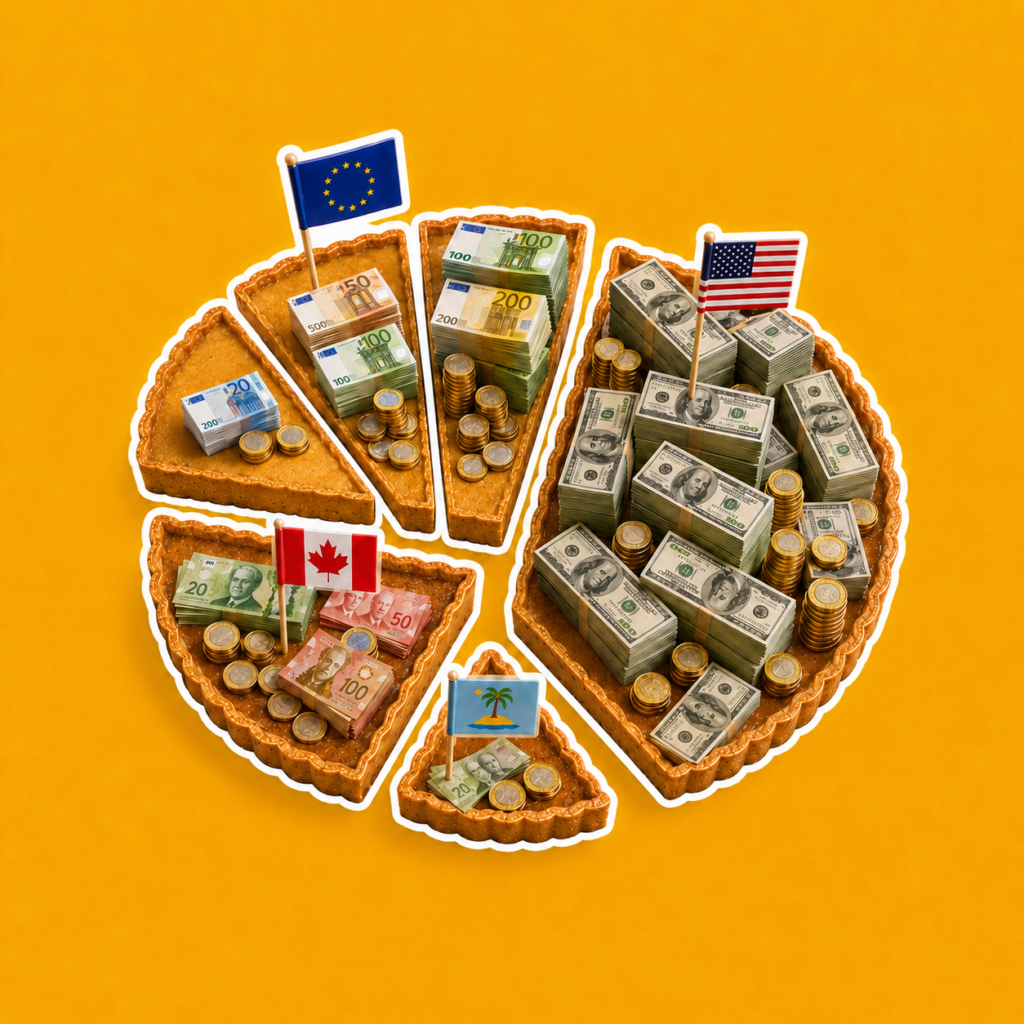
Anyone setting up a crypto business today runs into a genuinely confusing question fast: how much capital do you actually need to get licensed, and where does that money go furthest? The honest answer is that it depends less on ambition and more on geography, because MiCA, the North American patchwork, and the various offshore hubs all define «enough capital» in completely different ways — and the gap between them is bigger than most founders expect going in.
MiCA’s Tiered Capital System
MiCA doesn’t ask every crypto firm for the same pile of money. Article 67 and Annex IV split providers into three classes based on which services they’re licensed to offer, and each class comes with its own capital floor.
Class 1 covers the lighter services — executing orders, placing crypto-assets, transfer services, advice, and portfolio management — and only needs EUR 50,000 in permanent minimum capital. Class 2 layers on custody, administration, and exchange of crypto-assets for funds or other tokens, which pushes the floor to EUR 125,000. Class 3 is for firms running a full trading platform, and that’s where the requirement tops out at EUR 150,000. These classes stack, too — a firm offering both exchange services and custody doesn’t get to pick the lower tier; it lands in whichever class matches its highest-risk activity.
There’s a second test layered on top that trips a lot of firms up. MiCA requires holding whichever number is bigger: the class minimum, or a quarter of the firm’s fixed overheads from the year before. That overheads rule doesn’t matter much for a small Class 1 advisory shop with low costs, but it starts biting once a custodian scales up staff and compliance spend — suddenly that EUR 125,000 floor isn’t the real number anymore, and firms can find themselves needing considerably more just to keep pace with their own overhead growth.
What actually makes MiCA worth the extra capital, though, is what a single license buys. Get authorized in any one of the 27 EU member states, and passporting rights let that firm operate across the entire bloc without hunting down separate licenses — or separate capital pools — country by country. That’s the part that changes the math for anyone planning to operate at EU scale rather than just testing one market.
The US: No Single Number, No Single Regulator
North of the EU model, things get messier fast — and the US is really the poster child for regulatory fragmentation. There’s no federal crypto law playing the same role MiCA plays in Europe. Instead, firms are stuck navigating a multi-agency mess involving the SEC, the CFTC, FinCEN, OFAC, and fifty separate state money-transmitter regimes, each with its own rules.
Capital requirements swing wildly depending on which states a firm decides to operate in — anywhere from effectively nothing in some places to $10 million or more elsewhere. There’s nothing resembling MiCA’s clean EUR 50,000-to-150,000 bands here. Every state license comes bundled with its own net worth and bonding requirements, and firms trying to go national often end up stacking a dozen-plus state licenses on top of whatever federal registration they already carry.
That fragmentation gets expensive quickly. Firms chasing multi-state coverage in the US typically spend $500,000 to $3 million just on licensing, and ongoing compliance costs run another $1 million to $5 million a year for operations spread across multiple states. One estimate put annual money-transmitter license maintenance alone above $1 million for some firms — and that’s before any product or engineering spend gets factored in.
The GENIUS Act carved out one exception to all this. It gave stablecoin issuers a proper federal licensing path, complete with reserve segregation and bankruptcy protection rules that actually resemble what MiCA does for e-money tokens. But that’s really the only corner of US crypto regulation where something MiCA-like exists. Everywhere else, firms are stuck figuring out which agency claims jurisdiction over their token, then building compliance around whichever answer they land on.
Canada: Lighter on Capital, Heavier on Registration Friction
Canada takes a noticeably different path from its southern neighbor, and it’s worth treating separately rather than lumping it into «North America equals the US.» There’s no single crypto-specific statute here either, but the regulatory structure is far more centralized than the US patchwork, running through two main tracks.
The first is FINTRAC registration as a Money Services Business, which covers AML and reporting obligations under Canada‘s anti-money laundering law. This route is refreshingly light on capital — there’s no minimum capital requirement at all for FINTRAC MSB registration, and the whole process can be handled by non-residents, with total costs starting from roughly $11,500 and turnaround times that beat almost anything comparable in Europe or the US. That’s an enormous contrast with MiCA’s mandatory capital floors or the US state-by-state bonding requirements.
The second track is securities registration, and this is where things tighten up. Any platform that trades what Canadian regulators call «crypto contracts» — which covers most exchanges and custodial platforms — has to register as a dealer, typically through the restricted dealer category overseen by the Canadian Investment Regulatory Organization and provincial securities commissions like the Ontario Securities Commission. Capital requirements here vary by province and by the specific terms of a platform’s registration, generally landing somewhere between CAD 25,000 and CAD 100,000, though CIRO can impose additional working capital conditions tailored to a platform’s specific risk profile.
What makes Canada tricky isn’t the capital requirement itself — it’s actually one of the lower bars among developed markets — but the registration process. The CSA’s restricted dealer framework has been evolving constantly, and firms that received time-limited pre-registration undertakings have had to keep reapplying and adjusting to shifting terms and conditions as the CSA phases out that interim approach entirely. Several platforms that once operated under pre-registration undertakings have had those arrangements expire or get revoked, and a few have had registration applications formally refused. So while the money required is modest by MiCA or US standards, the bureaucratic runway to get and keep a Canadian license has proven genuinely unpredictable for platforms operating there.
Different Trade-offs
Offshore hubs aren’t really trying to go head-to-head with MiCA or North America on regulatory depth — that’s not the game they’re playing. Speed and cost, that’s the pitch. Take the UAE‘s Virtual Assets Regulatory Authority: fees are broken out by activity type, starting around AED 34,000 and going up past AED 600,000 if you want a wider scope of services. Still, that’s a lot less than MiCA’s higher capital tiers, and nowhere close to what firms end up paying once they’ve stacked several US state licenses on top of each other.
Then there’s the usual crowd — Cayman Islands, Seychelles, BVI — all built on the same reputation: get approved fast, keep the capital bar low. The catch is FATF grey-listing, which trips up quite a few of these jurisdictions when it comes to actually getting bank accounts opened or convincing institutional counterparties to work with you. None of these offshore licenses come with anything like MiCA’s EU-wide passporting either — a license in Seychelles gets you Seychelles, full stop. Firms operating out of these jurisdictions often carry a reputational discount when dealing with banks or institutional partners who now expect MiCA-grade oversight as the baseline rather than the exception.
A Side-by-Side View
Putting these numbers next to each other makes the structural gaps between these regimes obvious in a way that’s hard to see reading about each jurisdiction on its own.
What the Numbers Actually Mean
None of this boils down to «cheapest wins,» even though it’s tempting to read it that way at first glance. MiCA’s higher capital floors buy something none of the other regimes can match on their own: a single authorization that opens up a market of roughly 450 million people, plus a regulatory badge that’s increasingly non-negotiable for banks and institutional partners who’ve grown wary of lightly regulated crypto firms. For anyone planning to serve EU clients at real scale, a EUR 125,000 or EUR 150,000 capital requirement is arguably a bargain compared to piecing together a dozen separate US state licenses, each with its own bonding rules and its own compliance team keeping track of them.
The US framework rewards specialization more than anything else. A stablecoin issuer now has a real federal path through the GENIUS Act that starts to look like MiCA’s structured approach, while a firm dealing in tokens the SEC decides are securities ends up on a completely different, usually pricier, compliance track. That unevenness is exactly why plenty of US-based crypto firms have historically chosen to launch products offshore or in the EU first, before committing the capital needed for a full state-by-state US rollout.
Canada sits in an odd middle ground that doesn’t get talked about enough in these comparisons. The capital bar is genuinely low — lower than MiCA, lower than most US states — but the registration process itself has been a moving target, with pre-registration undertakings expiring, terms shifting, and at least one high-profile registration application getting refused outright. For a founder weighing options, that’s arguably a bigger risk factor than raw capital numbers, since predictable process matters just as much as cheap entry when you’re trying to build something durable.
Offshore jurisdictions still make the most sense for firms prioritizing speed to market and lower upfront capital over long-term institutional credibility. That calculus is shifting, though. More banks and payment partners are starting to treat MiCA authorization — or something comparably robust — as table stakes rather than a nice-to-have, and that’s putting real pressure on offshore-only operators to eventually pursue heavier regulation somewhere down the line if they want to keep growing.
For compliance teams weighing where to seek authorization, the real question isn’t just «what’s the minimum capital.» It’s what that capital actually buys — market access, banking relationships, institutional trust — and how predictable the path to keeping the license actually is once you’ve got it. MiCA’s tiered system, despite the added overhead, increasingly looks like the framework other jurisdictions are being measured against, whether they admit it or not.
Sources
1. ESMA – «Minimum Capital Requirements for Crypto-Asset Service Providers» – https://www.esma.europa.eu/publications-and-data/interactive-single-rulebook/mica/minimum-capital-requirements-crypto-asset
2. MiCA Regulation – Annex IV, Official Journal of the European Union – https://www.mica.wtf/mica/annex-iv
3. Ontario Securities Commission – «Crypto businesses» official registry page – https://www.osc.ca/en/industry/registration-and-compliance/crypto-businesses
4. Canadian Securities Administrators / IIROC – Joint Staff Notice on Compliance and Regulatory Requirements for Crypto Platforms – https://www.osc.ca/sites/default/files/2021-03/csa_20210329_21-329_compliance-regulatory-requirements.pdf
5. Baker McKenzie – Global Financial Services Regulatory Guide, Canada chapter – https://resourcehub.bakermckenzie.com/en/resources/global-financial-services-regulatory-guide/north-america/canada/topics/what-types-of-activities-require-a-license
6. VARA – «Licence Applications» official page – https://www.vara.ae/en/licenses-and-register/licence-applications/
7. Zola Group – «UAE Crypto Business Setup: Licenses, Costs, Regulators (2026)» – https://zolagroup.com/resources/uae-crypto-web3-business-setup
8. Tokenization Compliance – «MiCA vs. US Compliance Requirements: Regulatory Framework Comparison» – https://tokenizationcompliance.com/comparisons/mica-vs-us-compliance-requirements/
9. American Journal of Student Research – «Cryptocurrency Regulation: MiCA v.s. USA Framework» – https://ajosr.org/wp-content/uploads/journal/published_paper/volume-3/issue-6/ajsr2025_aWlgcNAe.pdf