For most people, it does not usually matter where a crypto exchange is registered. As long as trading works, balances match, and withdrawals go through, the jurisdiction behind the platform tends to stay out of sight. But by the end of June, that detail had suddenly become one of the main issues in the European crypto market.
The reason was MiCA, the EU’s new crypto framework. Its transition period ended on 1 July 2026, and from that point on, the right to serve European clients depended on having the proper authorisation.
That changed the conversation completely. What used to be a background compliance issue became a direct market access question.
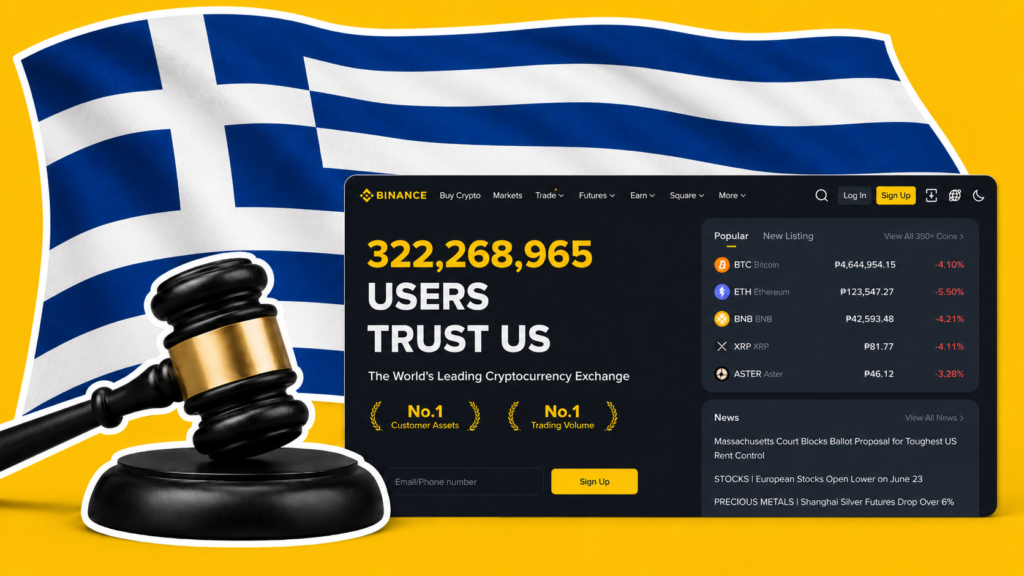
Binance tried to use Greece as its entry point. The idea was simple enough. Get one national approval and use it as a bridge into the wider EU market. On paper, that made sense. If Europe really wants a single market, then it should be possible to enter through one well chosen jurisdiction and expand from there. In practice, though, the application did not make it through, and Binance later withdrew it.
That matters because Binance is not just another exchange. It sits at the centre of a huge amount of crypto liquidity, which means a lot of trading across the market runs through it. When a platform like that is involved, the issue is no longer just one company’s licence. It becomes a test of whether Europe is actually willing to apply its new rules even when they affect one of the biggest names in the industry.
That is exactly what MiCA was meant to do. The whole point of the framework was to replace a patchwork of national regimes with one common system across the EU. Before MiCA, crypto companies often faced very different rules depending on the country. In some places the framework was strict and structured. In others, it was much looser. MiCA was supposed to bring order to that mix and make market access depend on one standard.
The transition period was always meant to be temporary. ESMA made it clear that it ended on 1 July 2026, and after that, firms without MiCA authorisation had to stop serving clients or begin winding down. In plain terms, that meant “we are still waiting for approval” was no longer a useful argument. The deadline had real consequences, and the market had to adjust to that.
That is also why Greece looked like such a sensible choice for Binance. The point was not the size of the Greek market itself. The real attraction was Greece as a gateway into all 27 EU member states. Richard Teng said the company saw the country as a strong base because of its talent pool, its security standards, and its potential as a European hub. That was the logic behind the application. The question was not whether Greece was big enough on its own. The question was whether it could serve as a credible bridge into the broader European market.
For users, the fallout is much more practical than political. It does not feel like a debate between Brussels and Athens. It feels like a notification in an app saying the service is no longer available in their country. After that, the real work begins. People have to move funds, look for another platform, check whether it is trustworthy, and see whether the liquidity is good enough. For traders, the impact is even sharper. They care less about the brand name and much more about execution, depth, and how active the market is.
That is why this became such a useful stress test for MiCA. A rulebook only matters if it applies the same way to everyone. It is easy to write a framework that works on paper. It is much harder to show that it still holds when it reaches the biggest players in the market. In this case, Europe made its position clear. MiCA is not a symbolic label and it is not a political promise. It is a real gatekeeper.
That changes the message for the rest of the market. The question is no longer whether a company can find a clever way into Europe. The real question is whether it is ready to work under a system that does not care how famous the brand is or how big the trading volume looks. For crypto firms watching the EU now, the lesson is simple. The market is open, but only to those willing to meet Europe on Europe’s terms.
Sources
Reuters. Binance set to lose permission to operate in EU, sources say.
https://www.reuters.com/business/finance/binance-set-lose-eu-licence-bid-permission-offer-services-bloc-say-sources-2026-06-16/
Reuters. Binance bets on Greek labour, security for EU growth, co-CEO Teng says.
https://www.reuters.com/sustainability/boards-policy-regulation/binance-bets-greek-labour-security-eu-growth-co-ceo-teng-says-2026-02-26/
ESMA. Statement on the end of transitional periods under MiCA.
https://www.esma.europa.eu/sites/default/files/2026-04/ESMA75-113276571-1679_Statement_on_the_end_of_transitional_periods_under_MiCA.pdf
ESMA. Statement on MiCA Transitional Measures.
https://www.esma.europa.eu/sites/default/files/2024-12/ESMA75-453128700-1396_Statement_on_MiCA_transitional_measures.pdf
ESMA. Markets in Crypto-Assets Regulation (MiCA).
https://www.esma.europa.eu/publications-and-data/interactive-single-rulebook/mica
Fortune. Binance applies to Greek regulators for MiCA license.
https://fortune.com/2026/01/22/binance-files-for-crucial-eu-wide-license-creates-greek-holding-company/
CoinGecko. Binance Statistics: Markets, Trading Volume & Trust Score.
https://www.coingecko.com/en/exchanges/binance
CoinGecko Research. Crypto Liquidity on CEXes 2025.
https://www.coingecko.com/research/publications/crypto-liquidity-report-2025